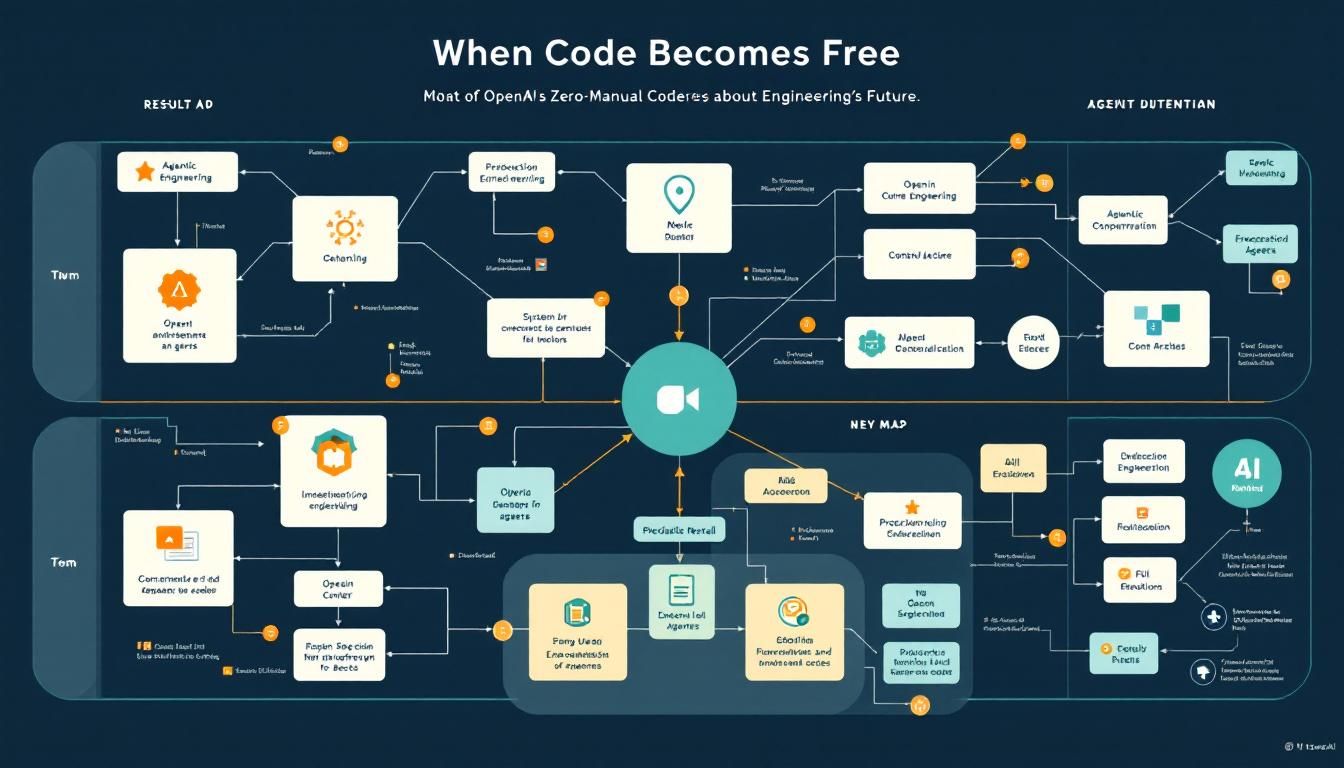
When Code Becomes Free: What OpenAI's Zero-Manual-Code Experiment Reveals About Engineering's Future
OpenAI shipped a real product for five months with one brutal rule: zero lines of human-written code. The results reveal a fundamental shift in what engineering actually becomes when agents do all the typing.
agentic engineeringautonomous AI developmentsystem design for agentsproduction AI workflowscodex
OpenAI just ran an experiment that should terrify and excite every engineer in equal measure. For five months, they built and shipped a real internal software product with one non-negotiable constraint: zero lines of manually written code.
Why This Changes Everything
This wasn't a demo or proof-of-concept. This was a production system with daily users, deployment pipelines, bugs that needed fixing, and features that needed shipping. The kind of messy, real-world software development that separates genuine capability from carefully curated demos.
Starting from an empty Git repository in late August 2024, OpenAI's team used Codex to generate everything — app logic, tests, CI/CD pipelines, documentation, observability tools, and internal utilities. Five months later: one million lines of code, 1,500 pull requests, and a team that scaled from three to seven engineers.
But here's what matters: this wasn't about coding faster. It was about fundamentally redefining what engineering means.
The Production Line Mindset
The throughput numbers tell a story that goes beyond impressive metrics. One million lines of code from a small team suggests something closer to industrial production than traditional software development.
The mental model shifted completely. Instead of engineers as craftspeople carefully shaping each function and class, the role became more like operators managing a production line. Humans steer, agents execute.
This creates a fundamentally different relationship with code:
- Traditional engineering: You think through the problem, architect the solution, and implement it line by line
- Agentic engineering: You define constraints, specify outcomes, and orchestrate systems that generate solutions
When something failed, the fix usually wasn't "prompt harder." The fix was: what capability is missing in the environment?
That single insight reveals everything about where this is heading. The debugging mindset changes from "what's wrong with this code" to "what's wrong with the system that produces this code."
The New Bottleneck: Human Attention
Here's the uncomfortable truth this experiment exposes: if agents can generate all the code, the scarce resource becomes human cognitive bandwidth. Specifically:
What You Choose to Specify
Every requirement, constraint, and business rule that doesn't get properly articulated becomes a source of system drift. Specification quality becomes the difference between a system that works and one that generates sophisticated garbage.
What You Choose to Review
With agents generating thousands of lines per day, comprehensive code review becomes impossible. Engineers must develop new intuitions about what to inspect, when to trust, and how to sample effectively across massive generated codebases.
What You Choose to Make Enforceable
The most critical decisions become architectural: which constraints can be automated, which feedback loops can be systematized, and which quality gates can be built into the generation process itself.
The engineer stops being the person who types the solution and becomes the person who designs the system that produces solutions.
This isn't just a workflow change — it's a complete redefinition of the engineering discipline.
Building Better Environments, Not Better Code
The OpenAI experiment reveals that agentic engineering success depends on environmental design rather than prompt optimization. When something broke, the solution wasn't better prompts — it was better structure, constraints, and feedback loops.
This suggests a new hierarchy of engineering skills:
- Systems thinking: Understanding how to create environments that produce reliable outputs
- Constraint design: Building guardrails that prevent entire classes of problems
- Feedback loop architecture: Creating systems that self-correct and improve over time
- Quality gate engineering: Designing automated validation that catches issues before they propagate
The Infrastructure Layer Becomes Critical
In this model, the foundational systems matter more than ever:
- Observability tools need to surface patterns across generated code
- Testing frameworks must validate behavior, not just implementation
- Deployment pipelines require new safety nets for AI-generated changes
- Documentation systems need to stay synchronized with rapidly evolving codebases
The irony? All of this infrastructure was also generated by Codex, including the initial scaffold and the files that told agents how to work within the repository.
The Question That Matters
OpenAI's experiment forces a fundamental choice: are we learning to write code faster, or learning to build better environments for agents to write code correctly?
The answer determines whether you're preparing for the future or optimizing for a world that's already disappearing. Prompt engineering might help you get better outputs today, but environment engineering determines whether you can build reliable systems at scale.
Consider the implications:
- Code review becomes system review
- Debugging becomes environment debugging
- Architecture becomes constraint architecture
- Testing becomes behavior validation
- Documentation becomes specification design
Each of these shifts requires fundamentally different skills and mental models.
The Bottom Line
OpenAI's zero-manual-code experiment isn't just impressive — it's a preview of engineering's inevitable future. When code generation becomes a commodity, human value shifts to system design, constraint architecture, and attention allocation. The question isn't whether this transition will happen, but whether you're building the skills to thrive when it does. The engineers who master environment design today will be the ones defining how software gets built tomorrow.
Try This Now
- 1Experiment with Codex or similar code generation tools to generate an entire small project without manual coding
- 2Practice designing system constraints and validation rules instead of writing implementation code
- 3Build feedback loops and observability into your development environment to catch AI-generated code issues early
- 4Develop skills in specification writing and requirement articulation for AI systems
- 5Study infrastructure-as-code and environment automation tools like Terraform, Docker, and CI/CD platforms
How many Orkos does this deserve?
Rate this tutorial