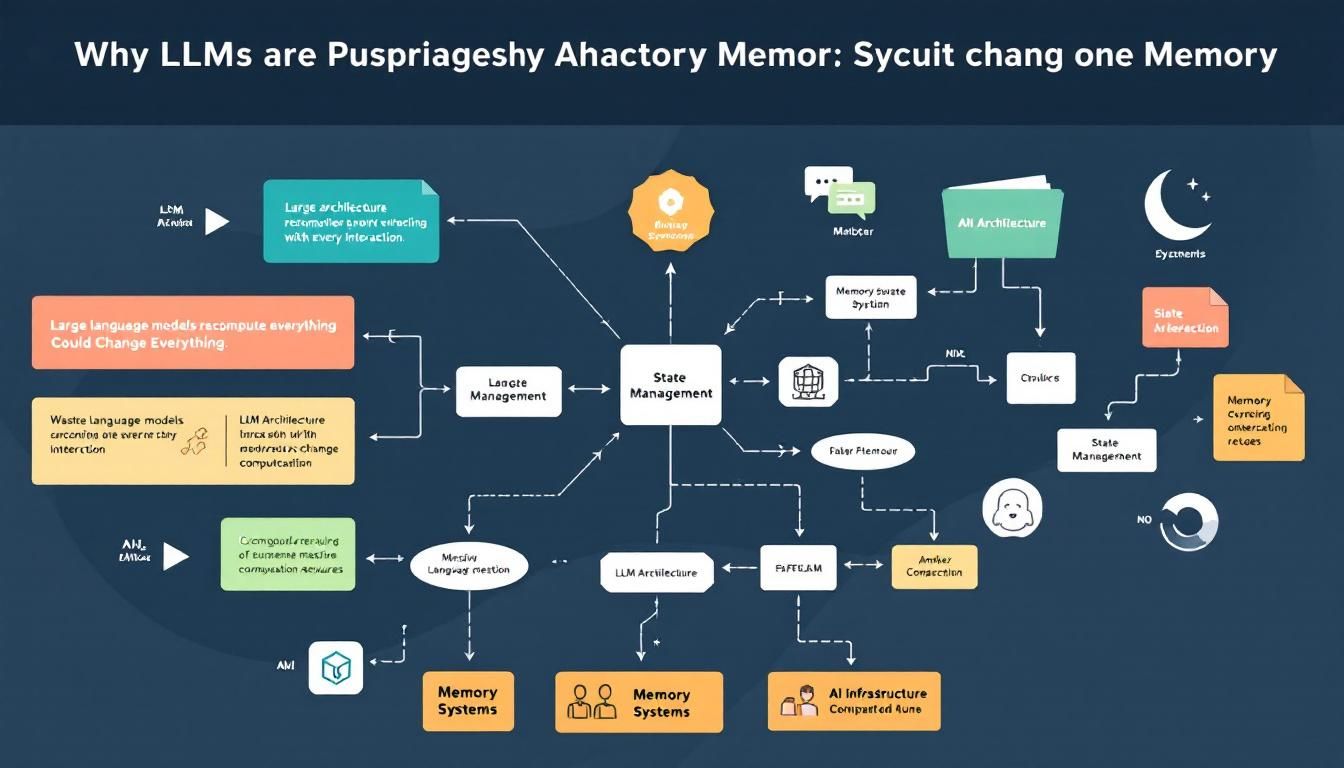
Why LLMs Are Surprisingly Dumb About Memory (And How State Systems Could Change Everything)
Large language models recompute everything from scratch with every interaction, wasting massive computational resources on basic questions. The solution might be surprisingly old-school: bringing back knowledge databases with a modern twist.
LLM ArchitectureState ManagementMemory SystemsAI InfrastructureKnowledge Databases
Every time you ask ChatGPT who the president was in 1980, it doesn't just look up a fact—it recomputes what "president" means, what "1980" refers to, and then works through the logical connections to arrive at "Ronald Reagan." It's like having a brilliant friend who develops amnesia every 30 seconds and has to rethink basic concepts from scratch.
Why This Matters: The Computational Waste Problem
This isn't just an academic curiosity—it's a fundamental inefficiency that's costing the AI industry billions in compute costs and limiting how smart our systems can actually become.
Current Large Language Models (LLMs) like GPT-4, Claude, and Llama operate in what we call a "stateless" mode. Every conversation is essentially:
- Take the entire conversation history
- Process it all from the beginning
- Generate the next response
- Forget everything and start over
This approach works, but it's incredibly wasteful. Imagine if you had to re-read every previous email in a thread just to write your next reply, every single time.
The current LLM paradigm is like hiring a genius consultant who shows up to every meeting with complete amnesia about your previous conversations.
The Architecture Problem: Why LLMs Can't Remember
To understand why this happens, you need to grasp how transformer architectures actually work under the hood.
The Context Window Trap
LLMs process information through what's called a context window—think of it as the model's "working memory." For GPT-4, this might be 32,000 tokens (roughly 24,000 words). Everything the model "knows" about your conversation has to fit in this window.
When you're having a long conversation:
- Early parts of the conversation get pushed out
- The model has to reprocess the entire remaining context each time
- Complex reasoning chains get recalculated from scratch
- No persistent knowledge accumulates between sessions
The Recomputation Tax
This creates what I call the "recomputation tax"—massive computational overhead for basic operations. When you ask a simple factual question like "What's the capital of France?", the model doesn't retrieve a stored fact. Instead, it:
- Processes your question through multiple attention layers
- Activates patterns learned during training about geography, countries, and capitals
- Generates "Paris" through a complex probability calculation
- Forgets this entire process immediately
The next time you ask about Paris, it starts over completely.
Current LLMs are like having a computer that has to reinstall its operating system every time you want to run a program.
The Old-School Solution: Knowledge Databases Redux
The irony is that we might be heading back toward approaches that AI researchers used decades ago—but with a modern twist.
How Inference Rule Systems Worked
Before the deep learning revolution, AI systems relied heavily on knowledge databases and inference rule systems. These systems:
- Stored facts in structured databases
- Used logical rules to derive new information
- Maintained persistent state between interactions
- Could build on previous reasoning
Systems like Prolog and expert systems were incredibly efficient at factual retrieval and logical reasoning, but they lacked the flexibility and natural language understanding that makes modern LLMs so powerful.
Enter nGrams and Hybrid Approaches
Newer approaches are emerging that combine the best of both worlds. nGrams and similar systems propose:
- Selective Memory: Instead of forgetting everything, identify and store important information
- External State: Maintain knowledge in separate, persistent databases
- Efficient Retrieval: Look up known facts instead of recomputing them
- Incremental Learning: Build on previous interactions rather than starting fresh
This isn't just about storage—it's about creating AI systems that can genuinely learn and remember across conversations.
The Technical Architecture
Here's how these hybrid systems might work:
Traditional LLM Flow:
User Input → Process Full Context → Generate Response → Discard State
State-Aware System Flow:
User Input → Check Knowledge Store → Retrieve Relevant Facts →
Process Only New Information → Generate Response → Update Knowledge Store
Practical Implications: What This Means for AI Development
Computational Efficiency
The efficiency gains could be enormous. Instead of using thousands of GPU hours to repeatedly figure out basic facts, systems could:
- Instantly retrieve known information
- Focus computational power on genuinely novel reasoning
- Handle much longer conversations without exponentially increasing costs
- Scale to support millions more users with the same hardware
Better User Experiences
From a user perspective, state-aware AI systems would feel fundamentally different:
- Persistent Learning: The AI remembers your preferences, communication style, and previous discussions
- Faster Responses: No need to reprocess basic information every time
- Deeper Conversations: Ability to build complex arguments over multiple sessions
- Personalization: Systems that genuinely adapt to individual users over time
New Capabilities Unlock
Persistent state enables entirely new AI applications:
- Research Assistants: That actually remember your research context across weeks or months
- Coding Partners: That understand your codebase architecture and remember past decisions
- Learning Tutors: That track your progress and adapt to your specific learning patterns
- Creative Collaborators: That maintain continuity across long-term creative projects
The difference between stateless and stateful AI isn't just technical—it's the difference between a tool and a true intellectual partner.
The Implementation Challenge
Technical Hurdles
Building state-aware AI systems isn't trivial. Key challenges include:
Storage Architecture: How do you efficiently store and index vast amounts of conversational context and learned facts?
Retrieval Systems: How do you quickly find relevant information from enormous knowledge stores?
Update Mechanisms: How do you decide what information is worth remembering vs. discarding?
Consistency Management: How do you handle conflicting information or outdated facts?
Infrastructure Requirements
These systems require entirely new infrastructure approaches:
- Distributed Knowledge Stores: Databases that can scale to billions of facts and rapid retrieval
- Vector Embeddings: For semantic similarity search across stored knowledge
- Graph Databases: To maintain relationships between concepts and facts
- Real-time Indexing: To immediately incorporate new information
Companies like Pinecone, Weaviate, and Chroma are building the infrastructure layer that makes this possible.
The Transition Path
We're already seeing early implementations:
- Retrieval-Augmented Generation (RAG): Systems that query external databases before generating responses
- Memory Networks: Neural architectures designed for persistent information storage
- Tool-Using LLMs: Models that can interact with external systems and databases
- Fine-tuned Specialists: Models trained on specific domains with built-in knowledge structures
The Bottom Line
The current generation of LLMs represents an incredible breakthrough in natural language understanding, but they're fundamentally limited by their inability to maintain state and learn persistently. The future of AI likely lies in hybrid systems that combine the linguistic sophistication of modern transformers with the efficiency and persistence of knowledge-based systems. This isn't just an incremental improvement—it's the foundation for AI systems that can genuinely grow smarter over time, remember what they've learned, and become true intellectual partners rather than impressive but forgetful tools. The companies and researchers who crack this problem first will build the next generation of AI that feels less like advanced autocomplete and more like genuine intelligence.
Try This Now
- 1Experiment with Retrieval-Augmented Generation (RAG) using Pinecone or Weaviate for your next AI project
- 2Evaluate memory-enhanced frameworks like LangChain's ConversationBufferMemory for persistent context
- 3Research vector databases like Chroma or Qdrant to understand state storage architectures
- 4Build a proof-of-concept chatbot that maintains conversation history across sessions using Redis or PostgreSQL
How many Orkos does this deserve?
Rate this tutorial