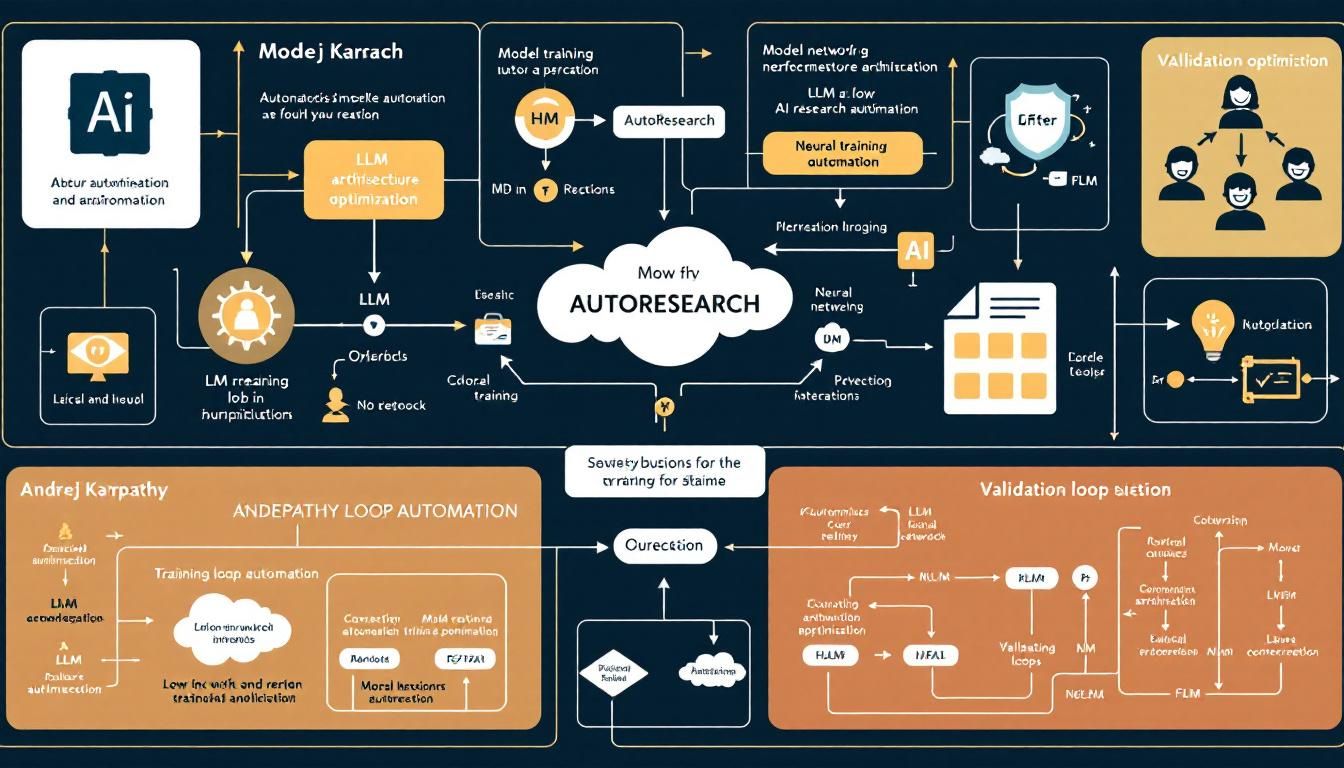
How Karpathy's AutoResearch Turns Your GPU Into an AI Research Lab While You Sleep
Andrej Karpathy just open-sourced a tool that autonomously modifies neural network architectures, runs training loops, and optimizes models overnight. Wake up to a fully documented research log and optimized LLM — no PhD required.
autonomous AI researchmodel training automationLLM architecture optimizationvalidation loop automation
Your GPU just became a tireless research assistant that works the night shift.
AutoResearch, the latest open-source release from Andrej Karpathy, represents a fundamental shift in how we approach machine learning experimentation. Instead of manually tweaking hyperparameters and architecture choices for weeks, you can now delegate that entire process to an AI agent that runs continuous experiments while you sleep.
Why This Changes Everything for ML Practitioners
Traditional machine learning research follows a painfully manual cycle: hypothesize, implement, train, evaluate, repeat. Even experienced researchers spend 80% of their time on mechanical tasks — adjusting learning rates, modifying layer dimensions, tweaking optimization schedules. The actual insights emerge from maybe 20% creative leaps buried in mountains of computational grunt work.
AutoResearch flips this equation. The system handles the entire experimental loop autonomously:
- Reads your instruction file and current model architecture
- Proposes architectural modifications based on learned patterns
- Executes a fixed 5-minute training run on a single GPU
- Evaluates validation loss to determine if changes improve performance
- Logs everything and either commits the change or reverts to the previous state
- Repeats this cycle continuously
The beauty isn't just automation — it's that you get a complete experimental log documenting exactly what was tried and why certain architectural choices emerged.
This matters because most breakthrough model improvements come from systematic exploration of architectural variations, not single eureka moments. AutoResearch can explore hundreds of variations in the time it would take you to manually test a dozen.
How the Autonomous Research Loop Works
The system operates on a surprisingly elegant principle: rapid iteration with automatic validation. Here's what happens during each cycle:
The 5-Minute Training Window
Each experimental run is capped at exactly 5 minutes of training time. This constraint serves two critical purposes:
- Fast feedback cycles: You get hundreds of data points overnight instead of waiting days for single experiments
- GPU efficiency: A single consumer GPU can run 100+ experiments in 8 hours
The agent doesn't try to fully train each variant — it just needs enough signal to determine if an architectural change shows promise. Early training dynamics often reveal whether a modification will succeed or fail.
Architecture Modification Engine
The AI agent can modify several key architectural components:
- Layer dimensions (hidden sizes, embedding dimensions)
- Attention mechanisms (head counts, attention patterns)
- Activation functions (ReLU vs GELU vs newer variants)
- Normalization strategies (LayerNorm placement and variants)
- Optimization parameters (learning rates, weight decay, schedules)
Think of it as having an experienced ML engineer who never gets tired, never makes transcription errors, and can hold dozens of experimental results in working memory simultaneously.
The Decision Framework
After each 5-minute training run, the system evaluates validation loss against the current best checkpoint. The decision logic is elegantly simple:
- Validation loss improved? → Commit the architectural change and continue from this checkpoint
- Validation loss degraded? → Revert to the previous architecture and try a different modification
- No clear signal? → Apply statistical tests to determine significance
Setting Up Your Overnight Research Lab
Getting AutoResearch running requires minimal setup, but the configuration choices significantly impact results.
Prerequisites and Installation
You'll need:
- Single GPU setup (RTX 3080/4080 or better recommended)
- PyTorch environment with CUDA support
- Sufficient disk space for model checkpoints and experiment logs
- Stable power/internet (you don't want experiments interrupted mid-cycle)
The installation follows standard GitHub patterns:
git clone https://github.com/karpathy/autoresearch
cd autoresearch
pip install -r requirements.txt
Configuring Your Instruction File
The instruction file serves as your research agenda. AutoResearch reads this to understand:
- Base model architecture to start from
- Dataset and training parameters
- Architectural components that are allowed to be modified
- Constraints and boundaries (maximum model size, minimum performance thresholds)
- Success criteria beyond just validation loss
A well-crafted instruction file might specify: "Start with a 6-layer transformer, explore attention head variations between 4-16 heads, maintain parameter count under 100M, prioritize improvements in mathematical reasoning tasks."
Running Your First Overnight Experiment
Launching an autonomous research session is remarkably straightforward:
python autoresearch.py --config your_instruction_file.yaml --duration 8hours
The system immediately begins its first experimental cycle. You can monitor progress through real-time logs, but the beauty is not needing to babysit the process.
The first time you wake up to 200+ completed experiments with detailed logs feels like magic — but it's just systematic exploration at machine speed.
What You Actually Get: Results and Insights
After an 8-hour overnight run, AutoResearch delivers several valuable outputs:
Comprehensive Experiment Logs
Every modification attempt gets logged with:
- Architectural changes made (specific parameters modified)
- Training curves from the 5-minute runs
- Validation metrics and comparison to baseline
- Decision rationale (why changes were kept or reverted)
- Resource utilization (GPU memory, training speed)
Optimized Model Architecture
The final model represents the accumulated wisdom of hundreds of micro-experiments. Often, the resulting architecture contains surprising combinations that human researchers might not have tried:
- Non-obvious attention head configurations
- Hybrid activation functions in different layers
- Novel normalization patterns
- Optimized dimension ratios
Research Insights and Patterns
Beyond the final model, the experiment logs reveal meta-insights about your specific dataset and task:
- Which architectural families consistently improve performance
- Parameter ranges that show diminishing returns
- Interaction effects between different components
- Training dynamics patterns that predict final performance
You're not just getting a better model — you're getting a research paper's worth of systematic exploration and documented insights.
The Bottom Line
AutoResearch represents the maturation of AI-assisted research from concept to practical tool. While it won't replace human creativity in defining research directions, it eliminates the tedious mechanical work that consumes most of an ML practitioner's time. The ability to explore hundreds of architectural variations overnight, with full documentation and statistical rigor, fundamentally changes the economics of machine learning research. For L3 practitioners ready to scale their experimental throughput, this tool transforms a single GPU into a tireless research lab that works while you sleep.
Try This Now
- 1Clone the AutoResearch repository from Karpathy's GitHub and set up the PyTorch environment
- 2Create your first instruction file specifying a base transformer architecture and modification constraints
- 3Run an overnight experiment session using AutoResearch with 8-hour duration on your current project
- 4Analyze the experiment logs to identify architectural patterns that consistently improve validation loss
- 5Document the meta-insights about your dataset's architectural preferences for future research directions
How many Orkos does this deserve?
Rate this tutorial