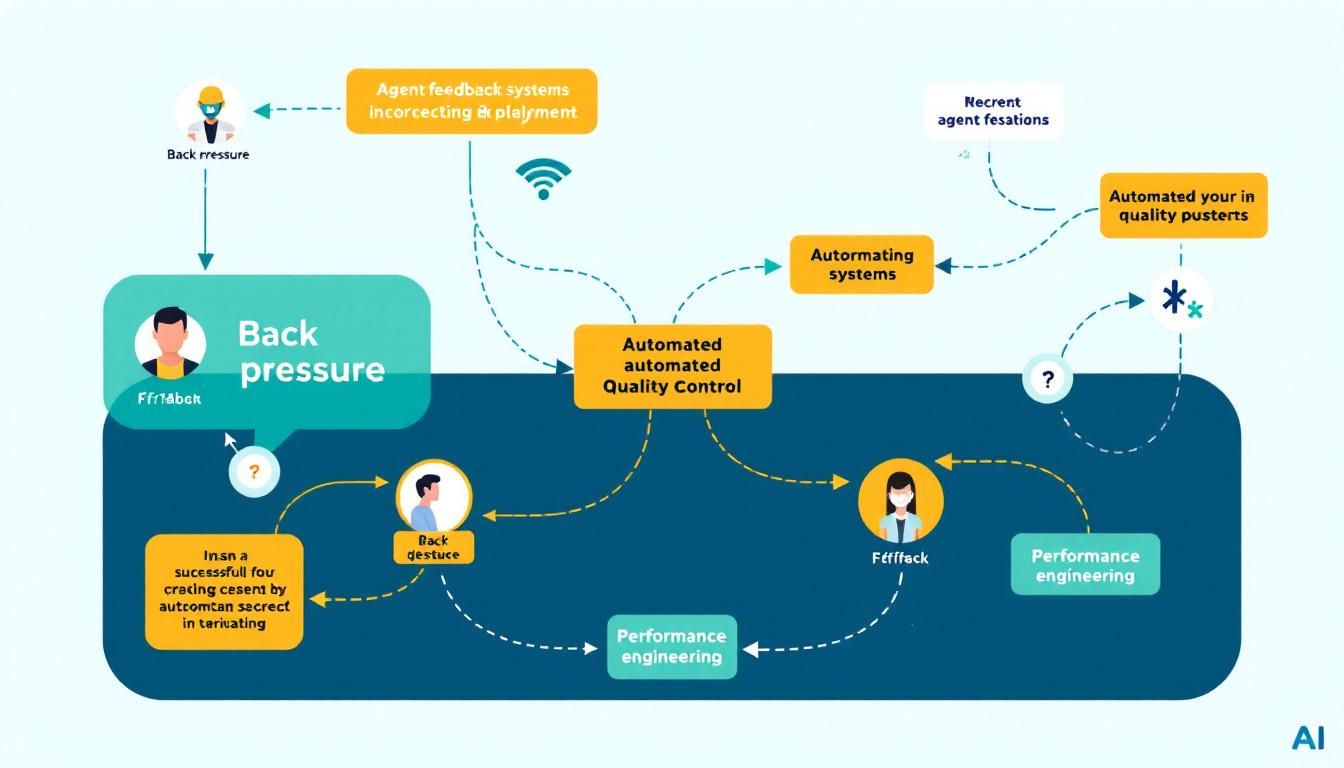
Don't Waste Your Back Pressure: The Missing Link in AI Agent Engineering
The most successful AI agents aren't just smarter—they have better feedback loops through back pressure systems that provide automated resistance and quality validation. By implementing structured feedback loops, fast validation cycles, and capturing back pressure data, engineers can delegate complex tasks to AI while maintaining quality control and preventing the "wheel from spinning" with invalid outputs.
back pressureagent feedback loopsautomated quality controlagentic engineeringfailure preventionpre-commitprek
The wheel keeps spinning, but sometimes that's exactly the problem.
While everyone's obsessing over bigger models and better prompts, the real breakthrough in AI agent engineering is happening in an unlikely place: back pressure systems. The agents that actually ship production code and handle complex, long-horizon tasks aren't necessarily running on the latest models—they're running on better feedback loops.
Why Back Pressure Engineering Matters Now
There's a pattern emerging among successful AI agent deployments that most people are missing. The projects that work—the ones actually delegating meaningful engineering tasks to agents—all share a common architecture: they've built sophisticated back pressure systems around their agents.
Back pressure in AI systems is the automated resistance that prevents agents from generating invalid outputs, similar to how back pressure in fluid dynamics prevents system overload.
This isn't just theoretical. Companies using agents for code generation, documentation, and system design are discovering that the difference between a hallucinating chatbot and a reliable engineering partner comes down to one thing: structured feedback loops that catch mistakes as they happen.
The stakes are higher than you think—without proper back pressure, you're not just wasting compute cycles, you're training yourself to distrust the very tools that could transform your productivity. As Geoffrey Huntley puts it: "If you aren't capturing your back-pressure then you are failing as a software engineer."
The Anatomy of Effective Agent Back Pressure
Automated Quality Gates
The most effective back pressure systems operate at multiple levels, creating what Geoffrey Huntley calls "just enough resistance" to reject invalid generations without grinding the system to a halt.
Immediate Feedback Loops:
- Pre-commit hooks (
prek,pre-commit) that validate code before it enters the system - Real-time linting and type checking that catches syntax errors instantly
- Automated test suites designed for speed and signal, not comprehensive coverage
Contextual Validation:
- Semantic analysis that checks if generated code matches intended functionality
- Integration testing that validates agent output against existing system constraints
- Domain-specific validators tailored to your particular engineering context
Under normal circumstances, pre-commit hooks are annoying because they slow down humans. But now that humans aren't the ones doing the software development, it really doesn't matter anymore.
The Performance Engineering Challenge
Here's where most teams get it wrong: they either implement no back pressure (leading to garbage output) or too much back pressure (making the system unusably slow). The sweet spot requires what Huntley describes as "part art, part engineering and a whole bunch of performance engineering."
Signs of Under-Pressure Systems:
- Agents generating syntactically correct but semantically meaningless code
- High rates of "hallucinated" function calls or API usage
- Output that looks right but fails basic integration tests
Signs of Over-Pressure Systems:
- Long feedback cycles that break agent context windows
- Excessive validation that catches edge cases but misses obvious errors
- Systems so slow that humans revert to manual work ("tests take a long time to run or for the application to compile")
Building Your Back Pressure Architecture
Start With Language and Tool Selection
Your choice of programming language and toolchain fundamentally determines how effective your back pressure can be. Strongly typed languages like Rust, TypeScript, or Go provide built-in resistance that catches entire classes of errors before they propagate.
Recommended Toolchain for AI Agent Back Pressure:
- Fast feedback tools:
prek(Rust-based pre-commit),eslintfor JavaScript,clippyfor Rust - Type-aware validation:
mypyfor Python, TypeScript for JavaScript, built-in checking for compiled languages - Rapid testing frameworks:
pytestwith parallel execution,jestwith watch mode,cargo nextestfor Rust - Integration validators: API contract testing, database migration validation, deployment smoke tests
Designing Agent-Friendly Test Suites
Traditional test suites optimize for human developer experience—comprehensive coverage, detailed error messages, and broad integration testing. Agent-optimized test suites prioritize different metrics:
Speed Over Completeness:
- Focus on tests that run in seconds, not minutes
- Prioritize unit tests and narrow integration tests
- Use test parallelization and smart test selection
Signal Over Noise:
- Write tests that fail clearly when agents make common mistakes
- Avoid flaky tests that provide false back pressure
- Include positive and negative test cases that guide agent behavior
Software engineering is now about preventing failure scenarios and preventing the wheel from turning over through back pressure to the generative function.
Implementing Feedback Collection
The most critical and overlooked aspect of back pressure engineering is capturing and learning from the resistance itself. Every time your system rejects agent output, that's valuable data about failure modes.
Essential Feedback Metrics:
- Rejection rates by error type (syntax, semantics, integration)
- Time-to-feedback for different validation layers
- False positive rates where back pressure rejected valid output
- Breakthrough failures where invalid output passed all checks
Practical Implementation: The Ralph Loop Pattern
Huntley references the "Ralph Loop"—a pattern where agents iterate through generation, validation, and refinement cycles until output meets quality thresholds. This isn't just theory; it's becoming the standard architecture for production AI engineering systems, especially in the "post loom/gastown era."
Setting Up Your First Ralph Loop
- Define Your Quality Gates: Start with basic syntax validation and one semantic check
- Implement Fast Feedback: Ensure your validation cycle completes in under 30 seconds
- Add Incremental Resistance: Layer additional checks as your system stabilizes
- Monitor and Tune: Continuously adjust back pressure based on failure patterns
Advanced Back Pressure Techniques
Context-Aware Validation: Train lightweight models to recognize when agent output diverges from project patterns and conventions.
Hierarchical Feedback: Implement multiple validation tiers—immediate syntax checking, delayed integration testing, and periodic comprehensive validation.
Adaptive Thresholds: Dynamically adjust back pressure based on agent performance history and task complexity.
Pre-Commit Automation: Leverage tools like prek (a Rust-based pre-commit system) to create automated resistance that doesn't slow down the development cycle since humans aren't the bottleneck anymore.
The Bottom Line
Back pressure engineering is rapidly becoming the differentiator between toy AI demonstrations and production-ready agent systems. The agents that will transform software development aren't just better at generating code—they're better at recognizing when their code is wrong through structured feedback loops that provide "automated feedback on quality and correctness."
As models become more capable, the bottleneck shifts from generation quality to feedback quality. Projects that successfully "setup structure around the agent itself" are the ones pushing agents to work on longer horizon tasks with maintained quality standards.
Engineers who master back pressure systems today will be the ones successfully delegating complex, long-horizon tasks to AI tomorrow. If you're not capturing and optimizing your back pressure, you're not just missing an optimization opportunity—you're missing the fundamental shift in how software gets built.
Try This Now
- 1Implement pre-commit hooks (like `prek`) and fast feedback tools in your development workflow
- 2Design agent-optimized test suites that prioritize speed over completeness and signal over noise
- 3Set up Ralph Loop patterns with quality gates, fast feedback cycles, and incremental resistance layers
- 4Start capturing and analyzing back pressure metrics including rejection rates, time-to-feedback, and failure patterns
- 5Choose strongly typed languages and toolchains that provide built-in resistance to common AI agent errors
How many Orkos does this deserve?
Rate this tutorial