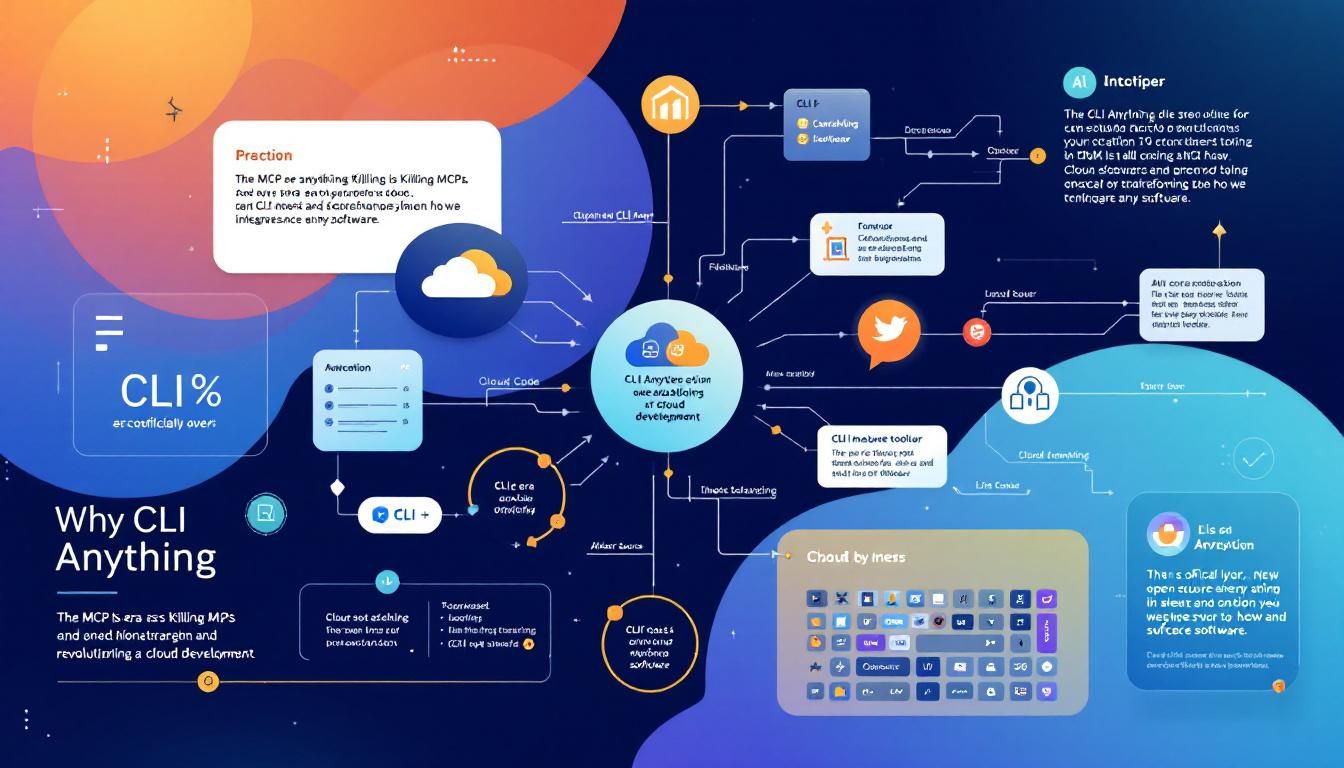
Why CLI Anything Is Killing MCPs and Revolutionizing Cloud Development
The MCP era is officially over. A new open-source tool called CLI Anything is transforming how we integrate any software with Cloud Code, and the developers behind LightRag and RagEverything are leading the charge.
CLI toolsCloud Code integrationopen source toolingCloud CodeCLI AnythingGitHub
The infrastructure world just shifted, and most developers didn't even notice.
Why This Matters: The Death of an Integration Era
For years, Model Context Protocol (MCP) has been the go-to standard for connecting AI systems with external tools and data sources. Developers have built entire workflows around MCP integrations, created specialized connectors, and invested countless hours mastering its intricacies.
That investment just became legacy code.
CLI Anything represents a fundamental shift in how we think about tool integration in cloud development environments. Instead of building custom MCP connectors for every piece of software you want to integrate with Cloud Code, you can now create a universal CLI interface that speaks to any open-source tool.
The shift from protocol-specific integrations to universal CLI interfaces isn't just about convenience—it's about developer velocity and the democratization of tool integration.
The CLI-First Future: Why Command Lines Are Winning
The writing has been on the wall for months. While everyone was building MCP connectors, the smartest teams were betting on CLI tools. Here's why they were right:
Universal Language of Software
Every serious piece of software has a command-line interface. From Docker to Kubernetes, from Git to Terraform, the CLI is the common denominator. When you build on CLI foundations, you're building on the most stable, widely-supported interface pattern in computing.
Zero Integration Overhead
With traditional MCP approaches, each new tool requires:
- Custom connector development
- Protocol mapping and translation
- Ongoing maintenance as APIs change
- Testing across different versions
CLI Anything eliminates this overhead entirely. If a tool has a command line (and they all do), it can integrate with Cloud Code immediately.
Developer Mental Model Alignment
Developers already think in terms of commands, flags, and outputs. CLI Anything leverages this existing mental model instead of forcing developers to learn yet another integration protocol.
CLI tools align with how developers naturally work, while protocol-based integrations force artificial abstractions that add complexity without delivering proportional value.
CLI Anything: The Technical Breakthrough
The team behind CLI Anything isn't a group of unknown developers taking a shot in the dark. These are the same engineers who built LightRag, RagEverything, and NanoClaw—tools that have quietly become infrastructure staples for AI-forward development teams.
How CLI Anything Works
The core concept is elegantly simple:
- Universal Wrapper: CLI Anything provides a standardized wrapper that can invoke any command-line tool
- Cloud Code Integration: The wrapper exposes a consistent interface that Cloud Code can understand and interact with
- Dynamic Discovery: Tools and their capabilities are discovered at runtime, not hardcoded during development
- Result Processing: Command outputs are automatically formatted and contextualized for Cloud Code consumption
Real-World Integration Examples
Instead of building separate MCP connectors for:
kubectl(Kubernetes management)helm(Kubernetes package management)aws cli(AWS resource management)gcloud(Google Cloud operations)terraform(Infrastructure as code)docker(Container operations)
You get instant integration with all of them through a single CLI Anything installation.
The Open Source Advantage
Being open source isn't just about cost—it's about evolution speed. When the tool is open source:
- Community contributions accelerate feature development
- Bug fixes happen faster than vendor support cycles
- Customization is possible when you need edge-case functionality
- No vendor lock-in concerns as your infrastructure scales
Open source tooling in infrastructure moves at the speed of developer need, not vendor roadmaps.
Installation and Getting Started
The CLI Anything installation process is refreshingly straightforward, especially compared to the multi-step MCP connector setups we're used to:
Basic Installation
# Clone the repository
git clone https://github.com/cli-anything/cli-anything
cd cli-anything

# Install dependencies
npm install

# Configure Cloud Code integration
npm run setup-cloud-code
Verification Steps
- Test CLI Detection: Verify CLI Anything can discover your installed tools
- Cloud Code Connection: Confirm the integration appears in your Cloud Code environment
- Sample Command: Run a test command through the interface to ensure end-to-end functionality
Configuration Customization
While CLI Anything works out of the box, you can customize:
- Which CLI tools are exposed to Cloud Code
- Command aliases for complex operations
- Output formatting preferences
- Security constraints for sensitive operations
The Strategic Implications: What This Means for Development Teams
CLI Anything isn't just a tool—it's a signal about where infrastructure tooling is headed.
For Individual Developers
- Reduced Learning Overhead: Master one integration pattern, access hundreds of tools
- Faster Prototyping: Integrate new tools without building custom connectors
- Consistent Experience: Same interface patterns across all your integrated tools
For Development Teams
- Lower Maintenance Burden: One integration to maintain instead of dozens of MCP connectors
- Faster Tool Adoption: Evaluate and integrate new CLI tools in minutes, not days
- Standardized Workflows: Team members work with tools through consistent interfaces
For Infrastructure Organizations
- Reduced Technical Debt: Fewer custom integrations to maintain and update
- Vendor Independence: Not locked into specific protocol implementations
- Future-Proofing: New CLI tools integrate automatically without additional development work
The organizations that recognize this shift early will have a significant velocity advantage over teams still investing in protocol-specific integrations.
The Bottom Line
CLI Anything represents more than just a new integration tool—it's evidence that the infrastructure world is consolidating around battle-tested patterns. While the industry spent years building elaborate protocol layers, the winning approach was hiding in plain sight: embrace the command line interfaces that already exist.
The MCP era taught us valuable lessons about tool integration, but it also showed us the limitations of protocol-centric approaches. CLI Anything learns from those limitations and builds on the solid foundation of command-line interfaces that have powered software for decades.
For development teams, the message is clear: the future belongs to those who can move fast and integrate seamlessly with the ever-expanding universe of CLI tools. CLI Anything makes that future accessible today.
Try This Now
- 1Install CLI Anything from the GitHub repository and test integration with your existing Cloud Code setup
- 2Audit your current MCP connectors to identify which ones can be replaced with CLI Anything integrations
- 3Experiment with integrating 3-5 CLI tools you regularly use through CLI Anything to evaluate the workflow improvements
- 4Join the CLI Anything community to stay updated on new features and integration patterns
How many Orkos does this deserve?
Rate this tutorial