Claude Opus 4.6: The AI Model That Finally Gets Long-Running Autonomous Work Done
Anthropic's latest Claude Opus 4.6 isn't just another incremental upgrade—it's the first AI model that can genuinely work autonomously for hours without human hand-holding. From managing 50-person engineering teams to migrating million-line codebases, it's redefining what we mean by 'AI agent.'
agentic aiautonomous codingmulti-agent systemsmodel capabilitiestool integrationClaude CodeDevinCursorReplitclaude.ai
The AI industry has been promising autonomous agents for years. We've seen demos, prototypes, and plenty of hype about AI systems that can work independently. But here's the uncomfortable truth: most AI models still need constant babysitting to accomplish anything meaningful.
Claude Opus 4.6 changes that equation in a fundamental way.
Why This Finally Matters
The leap from Claude Opus 4.5 to 4.6 represents something different than the usual model upgrades we've grown accustomed to. This isn't about slightly better benchmark scores or marginal improvements in code generation. According to Anthropic's release, this is about sustained autonomous work—the kind of long-running, multi-step tasks that actually matter in real organizations.
"Claude Opus 4.6 autonomously closed 13 issues and assigned 12 issues to the right team members in a single day, managing a ~50-person organization across 6 repositories." — Rakuten
The stakes here are enormous. We're moving from AI as a sophisticated autocomplete tool to AI as a genuine collaborator that can be trusted with complex, multi-day projects. The difference between these two paradigms will reshape how knowledge work gets done.
The Breakthrough: True Agentic Planning
What makes Opus 4.6 different isn't just raw intelligence—it's agentic planning at a level we haven't seen before. The model doesn't just respond to prompts; it actively breaks down complex problems, identifies dependencies, and works through multi-step processes without losing context or momentum.
The Technical Leap
Ophus 4.6 introduces several key capabilities that enable this autonomous behavior:
- 1M token context window: This massive context capacity means the model can hold entire codebases, documentation sets, and project histories in working memory
- Compaction: The ability to summarize its own context and continue working on long-running tasks without hitting limits
- Adaptive thinking: The model picks up contextual clues about how deeply to reason through problems
- Effort controls: Developers can dial intelligence up or down based on task complexity
Real-World Performance
The benchmark results tell a compelling story. On Terminal-Bench 2.0, an evaluation specifically designed for agentic coding tasks, Opus 4.6 achieved the highest score among all frontier models. But more impressively, on GDPval-AA—which tests economically valuable knowledge work across finance, legal, and other domains—it outperforms OpenAI's GPT-5.2 by 144 Elo points.
"Across 40 cybersecurity investigations, Claude Opus 4.6 produced the best results 38 of 40 times in a blind ranking against Claude 4.5 models." — NBIM
But the real proof comes from early access partners who've been using it in production environments.
Multi-Agent Teams: The New Paradigm
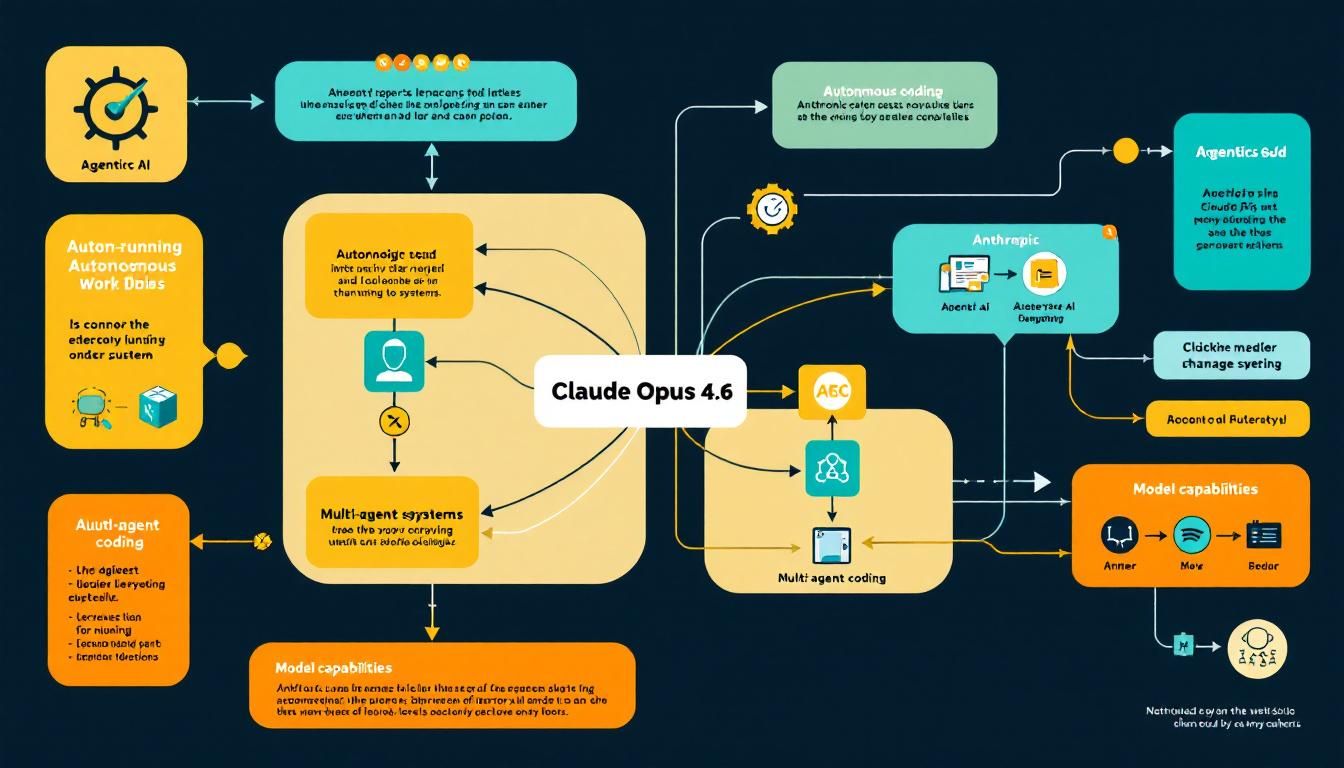
Perhaps the most significant development is Claude Code's agent teams functionality. Instead of a single AI trying to handle everything, you can now assemble specialized agents that collaborate on complex tasks.
This mirrors how high-performing human teams actually work:
- Task decomposition: The lead agent breaks down complex projects into manageable subtasks
- Parallel execution: Different agents work on independent components simultaneously
- Quality assurance: Specialized review agents catch errors and ensure consistency
- Integration: Results get synthesized into cohesive deliverables
The Shopify Experience
Shopify's feedback captures what this feels like in practice: "It felt like I was working with the model, not waiting on it." This subtle shift—from waiting on AI to collaborating with it—represents a fundamental change in human-AI interaction patterns.
SentinelOne reported that Opus 4.6 "handled a multi-million-line codebase migration like a senior engineer. It planned up front, adapted its strategy as it learned, and finished in half the time."
The model's ability to maintain context and adapt strategy mid-task is what separates genuine autonomy from sophisticated scripting.
Beyond Code: Enterprise Knowledge Work
While much of the early excitement focuses on coding capabilities, Opus 4.6's impact extends across knowledge work domains. The integration with Claude in Excel and the new Claude in PowerPoint preview signal Anthropic's push into everyday business workflows.
Financial Analysis and Research
The model excels at sustained analytical work—the kind of research and synthesis tasks that typically require hours of focused human attention. Box reported a 10% performance lift on multi-source analysis tasks, reaching 68% accuracy versus a 58% baseline.
Legal and Compliance Work
Harvey achieved a 90.2% score on BigLaw Bench, with 40% perfect scores. This suggests the model can handle the kind of nuanced legal reasoning that requires understanding complex regulatory frameworks and precedent analysis.
Creative and Design Work
Figma found that Opus 4.6 "generates complex, interactive apps and prototypes with an impressive creative range," often getting detailed multi-layered tasks right on the first attempt.
The Integration Challenge
The real test of any AI system isn't its standalone performance—it's how well it integrates into existing workflows and toolchains. Opus 4.6 ships with integrations across major platforms:
- Claude API with the
claude-opus-4-6model identifier - Major cloud platforms for enterprise deployment
- Office integration through Excel and PowerPoint
- Development environments via Claude Code and partner tools like Cursor and Windsurf
Pricing and Accessibility
At $5 input / $25 output per million tokens, the pricing remains unchanged from previous Opus models. This matters because it means organizations can upgrade to significantly more capable autonomous AI without restructuring their budgets.
The combination of dramatically improved capabilities at the same price point creates a compelling upgrade path for teams already using Claude in production.
The Bottom Line
Claude Opus 4.6 represents the first AI model that can genuinely work autonomously on complex, multi-day projects without constant human oversight. The combination of massive context windows, sophisticated planning capabilities, and multi-agent collaboration tools creates something qualitatively different from previous AI assistants. We're moving from AI that helps with tasks to AI that can own entire projects—and early production results suggest this isn't just marketing hype, but a fundamental shift in what's possible with artificial intelligence in professional environments. The question isn't whether this will change how knowledge work gets done, but how quickly organizations can adapt their workflows to leverage truly autonomous AI collaboration.
Try This Now
- 1Test Claude Opus 4.6 via the Claude API using model identifier `claude-opus-4-6` for your most complex coding or analysis tasks
- 2Experiment with Claude Code's agent teams feature to decompose large projects into collaborative AI workflows
- 3Evaluate Claude in Excel integration for financial modeling and data analysis workflows in your organization
- 4Set up compaction and adaptive thinking parameters to optimize performance for long-running autonomous tasks
- 5Benchmark Opus 4.6 against your current AI tools using your organization's most challenging multi-step problems
How many Orkos does this deserve?
Rate this tutorial