Beyond ChatGPT: How Multiplayer AI Is Breaking the Fourth Wall of Human-Machine Collaboration
The AI revolution is shifting from isolated tools to interconnected digital workers that coordinate, collaborate, and trade tasks among themselves at machine speed. We're entering the multiplayer era where agents stop being tools and start being teammates.
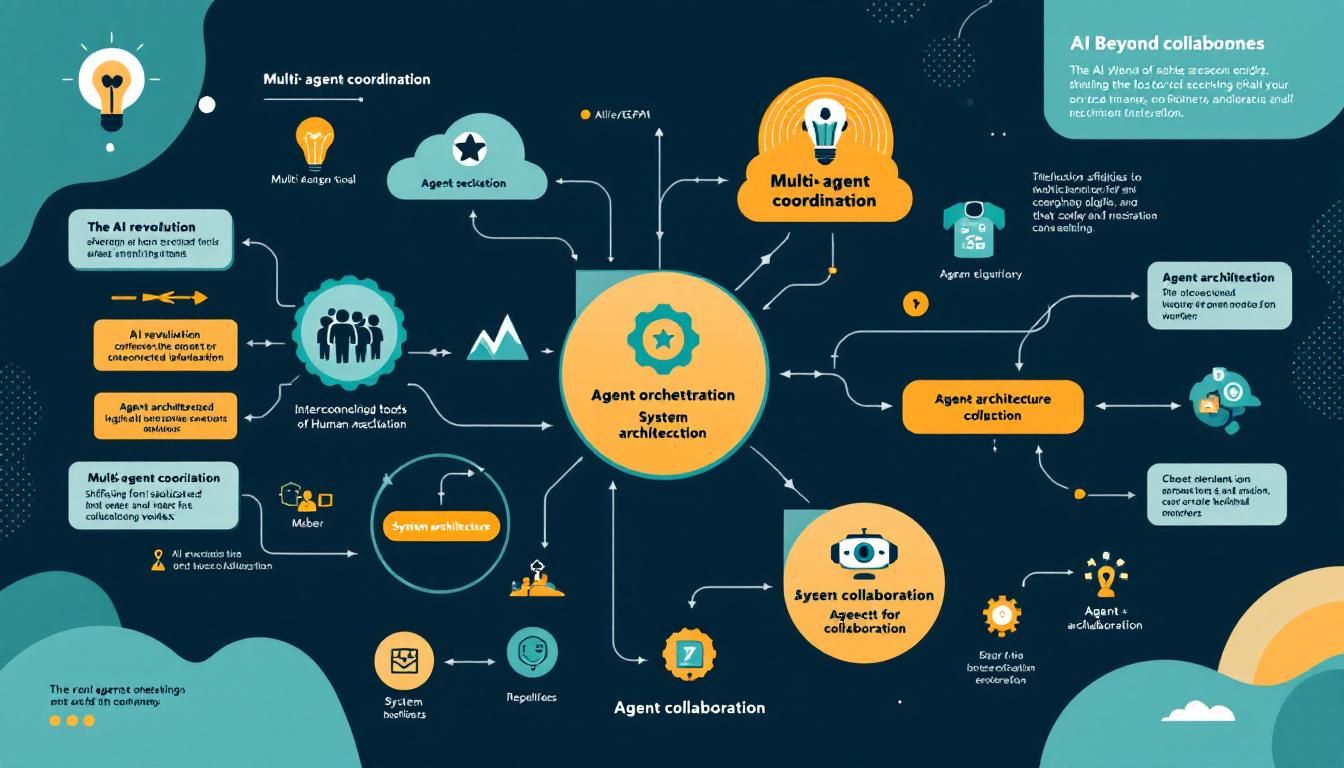
Multi-agent coordinationAgent orchestrationSystem architectureAgent collaborationChatGPT
The moment you add a fifth person to a four-person project, productivity doesn't just plateau—it crashes. This is the cruel mathematics of human collaboration, where communication overhead grows exponentially with each new participant. But multiplayer AI is rewriting these rules entirely.
Why This Matters: The End of AI Silos
We're witnessing the death of the single-user AI paradigm. While most organizations still treat AI tools like isolated calculators—one person, one chat, one task—the future belongs to systems where entire teams collaborate with AI in shared, persistent conversations. This isn't just a UI upgrade; it's a fundamental reimagining of how intelligence scales.
The implications ripple far beyond convenience. When AI can observe team dynamics, understand context across multiple participants, and maintain continuity across conversations, it transforms from a reactive tool into a proactive collaborator. We're not just getting better AI—we're getting AI that understands the human systems it serves.
Breaking the Fourth Wall: From Tool to Participant
Traditional AI interactions follow a rigid script: human asks, AI responds, conversation ends. Multiplayer AI breaks this fourth wall by embedding artificial intelligence directly into team discussions where it can observe, learn, and contribute contextually.
Consider the difference between these scenarios:
Traditional Approach:
- Designer creates mockup
- Uploads to ChatGPT individually
- Gets feedback in isolation
- Manually shares insights with team
- Developer separately asks AI about implementation
- Product manager separately queries about user impact
Multiplayer Approach:
- Designer shares mockup in team AI conversation
- AI observes real-time discussion between all stakeholders
- Provides contextual input considering design, technical, and business perspectives simultaneously
- Team builds shared understanding with AI as active participant
The shift from sequential AI consultations to simultaneous AI collaboration eliminates the telephone game effect where context gets lost in translation.
This transformation requires more than just adding a chat room to existing AI tools. The underlying architecture must evolve to handle multiple simultaneous users, maintain conversation state across participants, and understand the nuanced dynamics of team collaboration.
The Infrastructure Revolution: From Islands to Ecosystems
Today's AI landscape resembles isolated islands—each tool with its own interface, data, and capabilities. Agent orchestration demands a fundamental shift toward standardized protocols that allow any agent to read from and act upon any system without custom integrations.
Think of this evolution in three phases:
Phase 1: Tool Integration
Current solutions like Zapier and Make connect apps through APIs, but these are brittle point-to-point connections. Each integration requires manual configuration and breaks when either side changes.
Phase 2: Protocol Standardization
Emerging standards will allow agents to discover and interact with services automatically. Instead of pre-configured integrations, agents will negotiate capabilities and permissions dynamically.
Phase 3: Agent Interoperability
Ultimate goal: an agent mesh where specialized AI workers can collaborate across organizational and technical boundaries, trading tasks and sharing context seamlessly.
Companies building toward this future are already seeing dramatic efficiency gains. Anthropic's Claude can now access multiple tools within a single conversation, while OpenAI's GPT-4 with function calling demonstrates how agents can orchestrate complex workflows across systems.
The future infrastructure won't just connect our tools—it will create a nervous system for digital work where intelligence flows freely between specialized agents.
The Coordination Challenge: Enter the Three W Pattern
As agents proliferate and gain system access, coordination becomes the critical bottleneck. This is where coordinator agents emerge—specialized AI systems that master what we call the Three W Pattern:
Who Should Act?
- Which agent has the right capabilities for this task?
- Who has the necessary permissions and context?
- Which agents are currently available versus busy?
When to Step In?
- Is this the right moment to escalate or delegate?
- Should we wait for more information or act on current data?
- How do we balance urgency with thoroughness?
What Actually Matters?
- Which tasks deserve immediate attention?
- What can be automated versus requiring human oversight?
- How do we prioritize competing objectives?
Real-world implementation might look like this:
- Customer support agent receives complex technical query
- Coordinator agent analyzes the request and determines it needs:
- Product knowledge (documentation agent)
- Technical expertise (engineering agent)
- Customer context (CRM agent)
- Coordinator orchestrates the collaboration, ensuring each agent contributes appropriately
- Synthesis agent combines insights into coherent customer response
- Quality agent reviews before human approval
Companies like Microsoft are already implementing coordinator patterns in Microsoft 365 Copilot, where different AI capabilities are orchestrated based on user context and task requirements.
Digital Workers: The Reliability Economy
When coordination problems are solved, something remarkable happens—agents stop acting like tools and start behaving like digital workers. They develop reputations, build partnerships, and trade tasks based on capability and reliability scores.
This creates an internal economy of AI agents:
Reliability Scoring:
- Task completion rates
- Quality metrics from previous work
- Speed and resource efficiency
- Ability to collaborate effectively with other agents
Task Trading:
- Agent A specializes in data analysis but is overloaded
- Agent B has capacity and complementary skills
- Coordinator facilitates task transfer with context preservation
- Both agents update reliability scores based on outcomes
Partnership Formation:
- Agents that work well together get paired more frequently
- Successful collaborations build "trust scores"
- Failed partnerships trigger automatic reassignment
We're moving toward AI ecosystems where reputation and reliability matter as much as raw capability—just like human professional networks.
Early examples are already emerging. GitHub Copilot learns from successful code patterns, while Salesforce Einstein builds confidence scores for different types of predictions. The next evolution will see these systems actively choosing collaboration partners based on past success.
The Machine Speed Advantage
The ultimate promise of multiplayer AI lies in machine-speed coordination. While human teams are limited by meeting schedules, time zones, and communication bandwidth, agent teams can coordinate in milliseconds.
Consider a complex business decision that traditionally might take days:
Traditional Timeline:
- Day 1: Initial analysis by analyst
- Day 2: Review meeting with stakeholders
- Day 3: Additional research requested
- Day 4: Follow-up analysis
- Day 5: Final decision meeting
Machine-Speed Timeline:
- Millisecond 1: Coordinator agent identifies decision need
- Millisecond 10: Multiple specialist agents begin parallel analysis
- Millisecond 100: Agents share findings and identify conflicts
- Millisecond 500: Synthesis agent creates comprehensive recommendation
- Second 1: Human receives complete analysis with confidence scores
This isn't science fiction—it's the logical endpoint of current technological trends combined with multiplayer coordination.
The Bottom Line
The shift to multiplayer AI represents more than technological evolution—it's a fundamental reimagining of how intelligence scales in organizations. By breaking the fourth wall between human teams and AI capabilities, standardizing agent interoperability, and solving coordination through the Three W pattern, we're building systems that operate at machine speed while maintaining human oversight and values. The organizations that master this transition first will gain an insurmountable advantage in an increasingly AI-native world, while those clinging to single-user AI paradigms will find themselves outmaneuvered by competitors whose digital workers collaborate as seamlessly as their human teams.
Try This Now
- 1Experiment with multiplayer AI features in ChatGPT Team or Claude for Organizations to understand shared context benefits
- 2Audit your current AI tool stack for integration opportunities using Zapier or Make as stepping stones toward agent orchestration
- 3Design a simple coordinator agent workflow using OpenAI's function calling to manage task routing between different AI capabilities
- 4Establish reliability metrics for your AI tools to begin building internal reputation systems for agent performance
- 5Map out your organization's decision-making processes to identify where machine-speed coordination could compress timelines from days to minutes
How many Orkos does this deserve?
Rate this tutorial