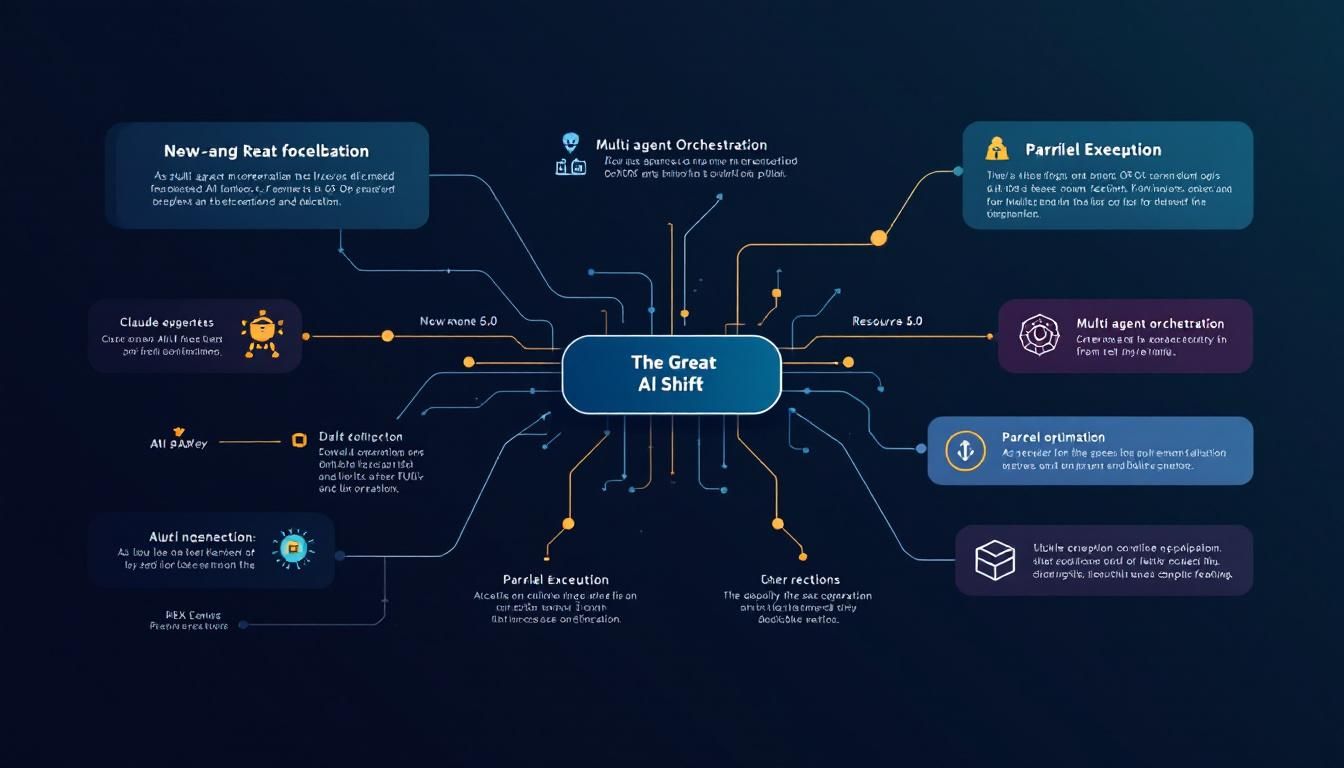
The Great AI Shift: Why Model Orchestration Beats Model Selection in the Sonnet 5.0 Era
As Claude Sonnet 5.0 approaches with Opus-level capabilities at a fraction of the cost, the bottleneck shifts from picking the right AI model to orchestrating multiple agents in parallel. The future belongs to those who can keep five terminals running 24/7, not those who craft the perfect single prompt.
multi-agent orchestrationparallel executionAI model optimizationresource managementClaude
The AI arms race just shifted from quality to quantity, and most people haven't noticed yet.
Why This Changes Everything
We're standing at an inflection point that will reshape how we think about AI productivity. Claude Sonnet 5.0 is rumored to deliver Opus 4.5-level performance at a significantly lower cost and with expanded context windows. This isn't just another model upgrade—it's the moment when AI capability becomes abundant enough to fundamentally change our approach.
The old paradigm was scarcity-driven: carefully select the right model for each task, craft the perfect prompt, and use your limited tokens wisely. The new paradigm is abundance-driven: deploy multiple agents simultaneously, orchestrate parallel workflows, and never let your AI capacity sit idle.
The shift isn't about using AI better—it's about using AI constantly.
This transition mirrors what happened in cloud computing when storage and compute became cheap enough to change architectural patterns entirely. We stopped optimizing for minimal server usage and started optimizing for maximum throughput.
From Model Selection to Model Orchestration
The Old Bottleneck: Choosing Wisely
Until now, the primary skill was model selection—knowing when to use GPT-4 for complex reasoning, Claude Opus for nuanced writing, or GPT-3.5 for simple tasks. We operated like resource-constrained engineers, carefully allocating our most powerful tools to the most deserving problems.
This approach made sense when:
- High-capability models were expensive
- Context windows were limited
- Each query carried significant cost implications
- Quality models required careful prompt engineering
The New Bottleneck: Orchestrating Scale
With Sonnet 5.0 delivering flagship performance at commodity prices, the constraint shifts entirely. The question becomes: how many parallel workflows can you effectively manage?
As one Anthropic team member put it, their role is to "unhobble Claude from themselves"—removing the human typing bottleneck that prevents AI from reaching its full potential. This insight reveals the new competitive landscape.
When AI capability becomes abundant, human orchestration becomes the scarce resource.
The winners will be those who can:
- Maintain 3-5 terminal windows with active agents
- Design parallel workflows that compound productivity
- Create feedback loops between different agent outputs
- Optimize for continuous execution rather than perfect single outputs
The Architecture of Always-On AI
Multi-Terminal Mastery
The practical reality of this shift means rethinking your workspace entirely. Instead of one carefully crafted conversation, imagine:
Terminal 1: Content research agent continuously gathering and synthesizing information Terminal 2: Code generation agent iterating on implementation details Terminal 3: Quality assurance agent reviewing and refining outputs from other terminals Terminal 4: Project management agent tracking progress and identifying bottlenecks Terminal 5: Creative exploration agent testing unconventional approaches
Each agent operates independently but feeds into a larger workflow. The magic happens in the orchestration layer—how you design handoffs, manage dependencies, and synthesize outputs.
Plan Mode Excellence
With abundant AI capacity, plan mode usage becomes critical. Instead of reactive prompting, successful orchestrators will:
- Define comprehensive project scopes that can be broken into parallel workstreams
- Create decision trees that route different types of problems to appropriate agents
- Design feedback mechanisms that allow agents to improve each other's work
- Establish quality gates that maintain standards across parallel outputs
The best AI orchestrators think like conductors, not soloists.
Resource Management at Scale
This abundance model requires new disciplines:
- Context window optimization: Designing workflows that maximize the utility of expanded context limits
- Inter-agent communication: Creating protocols for agents to share relevant information without overwhelming each other
- Output synthesis: Developing systems to merge parallel workstreams into coherent final products
- Continuous monitoring: Tracking which agents are producing value and which are spinning their wheels
Practical Implementation Strategies
Start with Three-Agent Architecture
Don't jump straight to five terminals. Begin with a triangle pattern:
- Generator Agent: Produces initial outputs based on your requirements
- Critic Agent: Reviews and identifies improvement opportunities
- Synthesizer Agent: Combines feedback into refined final versions
This creates a continuous improvement loop that runs automatically while you focus on higher-level orchestration.
Design for Parallel Discovery
The real power emerges when agents explore different solution paths simultaneously:
- Agent A: Pursues the obvious, conventional approach
- Agent B: Explores creative, unconventional alternatives
- Agent C: Focuses on edge cases and potential failure modes
- Agent D: Optimizes for speed and efficiency
- Agent E: Prioritizes thoroughness and comprehensiveness
You then synthesize insights from all approaches rather than committing to a single path upfront.
Build Feedback Systems
Create mechanisms for agents to learn from each other:
- Cross-pollination prompts: "Review Agent B's approach and identify elements that could improve your current solution"
- Competitive dynamics: "Agent C just proposed X solution—can you develop something more effective?"
- Collaborative refinement: "Combine the best elements from all previous approaches into a unified solution"
The Skills That Matter Now
Problem Decomposition
The most valuable skill becomes breaking complex challenges into parallelizable components. Instead of crafting one perfect prompt, you need to:
- Identify which aspects of a problem can be solved independently
- Design clear interfaces between different workstreams
- Anticipate where parallel work might conflict or duplicate effort
- Create integration points where separate outputs combine effectively
Continuous Orchestration
Success requires developing systems thinking:
- Workflow design: Creating repeatable processes that leverage multiple agents effectively
- Bottleneck identification: Recognizing when human input is blocking AI progress
- Quality assurance: Maintaining standards when managing multiple parallel outputs
- Strategic direction: Ensuring all agents work toward coherent goals
The future belongs to AI conductors who can keep entire orchestras playing in harmony.
Creative Problem Generation
Perhaps counterintuitively, problem identification becomes more valuable than problem-solving. With abundant AI capability, the constraint shifts to:
- Identifying opportunities worth pursuing
- Framing problems in ways that leverage AI strengths
- Designing projects that benefit from parallel exploration
- Recognizing when human creativity should guide AI execution
The Bottom Line
The Sonnet 5.0 era represents a fundamental shift from AI as a carefully rationed resource to AI as abundant infrastructure. The companies and individuals who adapt first will gain massive advantages by thinking in terms of orchestration rather than optimization. While others debate the perfect prompt, winners will be running five agents simultaneously, building feedback loops between them, and scaling their creative output by orders of magnitude. The question isn't whether you can use AI well—it's whether you can use AI constantly, strategically, and at scale.
Try This Now
- 1Set up 3 parallel Claude Sonnet terminals running different aspects of your next project
- 2Design a triangle workflow with Generator, Critic, and Synthesizer agents for your most frequent tasks
- 3Create cross-pollination prompts that allow your agents to learn from each other's outputs
- 4Identify your biggest project and decompose it into 5 parallelizable workstreams
- 5Build a feedback system where Agent outputs automatically improve through competitive iteration
How many Orkos does this deserve?
Rate this tutorial